
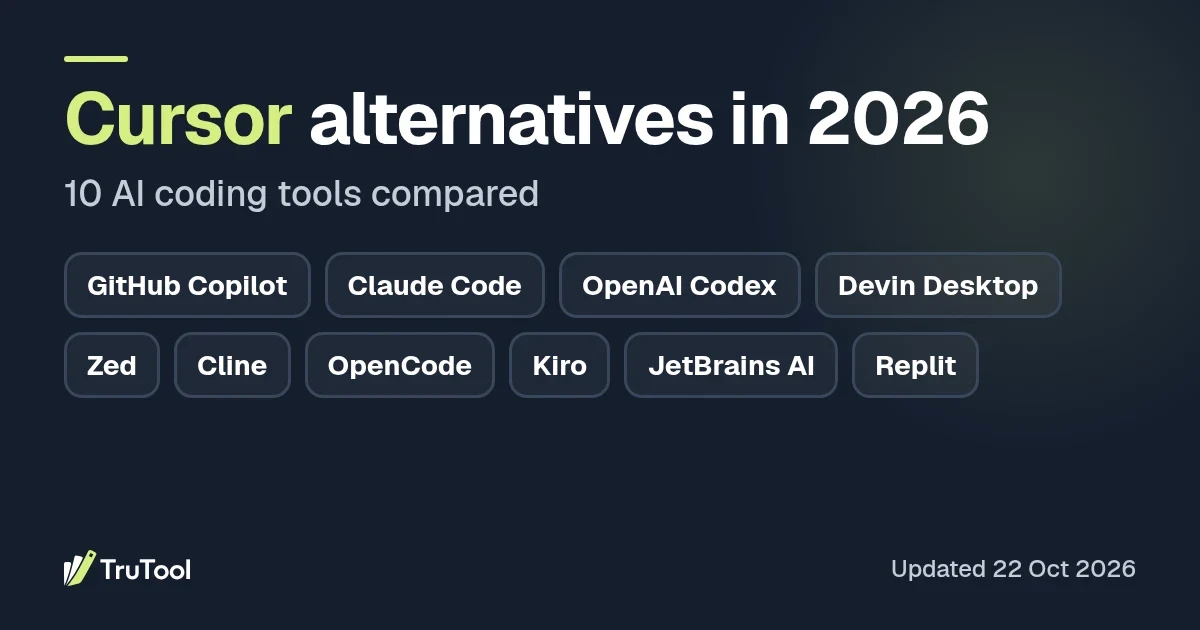
The best Cursor alternatives in 2026 are GitHub Copilot for the cheapest full-featured paid plan, Claude Code and OpenAI Codex for agent-heavy work, and Devin Desktop (formerly Windsurf) for the closest editor swap. If you want a free Cursor alternative, Cline, OpenCode and Zed let you bring your own model keys or use free models.
Cursor is now sold directly through X Subscription Corp., with plans from Free to Ultra at $200 a month (Cursor pricing). Every price below was checked on the vendor's official pricing page on 22 Oct 2026.
We ranked the tools in three groups. First come subscriptions that include models in the price, ordered by entry paid price (GitHub Copilot at $10, then Claude Code, OpenAI Codex and Devin Desktop at $20). Next are free tools where you bring your own models (Zed, Cline, OpenCode), and last are tools that fit a narrower setup (Kiro, JetBrains AI, Replit).
Quick answer: what are the best Cursor alternatives?
The best Cursor alternatives by need:
- GitHub Copilot: best low-cost paid plan, with Pro at $10 a month.
- Claude Code: best for terminal agents on Claude models, from $20 a month with Claude Pro.
- OpenAI Codex: best if you already pay for ChatGPT, with full Codex access from Plus at $20 a month.
- Devin Desktop (formerly Windsurf): best like-for-like AI editor, with Pro at $20 a month.
- Zed: best fast, open source editor, free with your own API keys.
- Cline: best free, open source agent inside VS Code.
- OpenCode: best free, open source terminal agent that reuses your existing subscriptions.
- Kiro: best for clear credit pricing.
- JetBrains AI: best for teams already in JetBrains IDEs.
- Replit: best for building and hosting apps in the browser.
How do the 10 Cursor alternatives compare?
| Tool | Type | Best for | Entry paid price | Free option | Claude and GPT in plan? |
|---|---|---|---|---|---|
| GitHub Copilot | Editor extension and agent | Cheapest paid plan | Pro $10/mo; Business $19/seat | Yes, limited | Usage drawn from GitHub AI Credits |
| Claude Code | Agent | Terminal agents on Claude | Claude Pro $20/mo ($17/mo yearly) | No | Claude models only |
| OpenAI Codex | Agent | ChatGPT subscribers | Plus $20/mo (Go $8/mo is limited) | Yes, limited | OpenAI models only |
| Devin Desktop (formerly Windsurf) | Editor | Closest editor swap | Pro $20/mo | Yes, light quota | Pro includes OpenAI, Claude, Gemini and SpaceXAI models |
| Zed | Editor (open source) | Fast editor with your own keys | Pro $10/mo; Business $30/seat | Yes, with your own keys | Via $5 of included tokens or your keys |
| Cline | Agent (open source) | Agent in VS Code | No subscription | Yes | Pay at cost or use your own keys |
| OpenCode | Agent (open source) | Terminal agent | No subscription | Yes, with free models | Via your keys or existing subscriptions |
| Kiro | Editor and agent | Clear credit pricing | Pro $20/mo | Yes, 50 credits | Pro includes Claude Sonnet 5 and Claude Opus 5 |
| JetBrains AI | IDE add-on | JetBrains IDE users | AI Pro $10/mo | Yes, 3 credits per 30 days | Usage drawn from AI credits |
| Replit | Platform | Browser app building | Core $20/mo ($18/mo yearly) | No standalone free plan listed | $20 toward stronger models on Core |
Prices are in USD before tax, from each vendor's pricing page on 22 Oct 2026.
Why are developers leaving Cursor in 2026?
Cost and model access are the main reasons. Cursor's Plus plan includes Grok models only, and its FAQ says Premium and above do not include an allowance for third-party models, so Claude and GPT in Cursor are paid at API list price (Cursor pricing).
Usage now comes from one pool shared across Cursor and Grok, with a weekly refresh.
| Cursor plan | Price | What you get |
|---|---|---|
| Free | $0 | Limited agent and chat requests |
| Plus | $8/mo | Shared usage pool, Grok models only |
| Premium | $30/mo | 4x Plus usage, third-party models at API list price |
| Super | $100/mo | 15x Plus usage, priority access at peak times |
| Ultra | $200/mo | 50x Plus usage, earliest access to models |
| Teams | $30+/user/mo | Pooled usage |
1. GitHub Copilot: which Cursor alternative is cheapest?
GitHub Copilot has the lowest entry paid plan of the subscription picks, at $10 a month for Pro. Its free plan includes limited chat and agent usage and supports the CLI and agent mode (GitHub Copilot plans).
If your work lives on GitHub, Copilot is the most direct switch, since code review, Copilot in the cloud and the Copilot app run inside GitHub. It also works in VS Code.
Strengths
- Pro+ is $39 and Max is $100 a month, with total GitHub AI Credits of $15, $70 and $200 across Pro, Pro+ and Max.
- Copilot Business costs $19 per seat a month and Enterprise $39 per seat a month (GitHub Docs).
Weakness
- Part of each plan's credits is a "flex allotment" that GitHub says may change over time, so monthly capacity is less predictable than the sticker price.
Best for: developers who work on GitHub.
2. Claude Code: which Cursor alternative is best for agent work on Claude?
Claude Code is the strongest choice if Claude models were your main reason for using Cursor. It comes with Claude Pro and Max, so you pay a flat subscription and skip API metering (Claude pricing).
Strengths
- Max starts at $100 a month with a choice of 5x or 20x Pro usage.
- Team premium seats with Claude Code cost $100 per seat a month billed yearly, or $125 monthly.
Weakness
- Claude Code is not on the free plan, and every plan has usage limits. Max starts at five times the Pro price.
Best for: terminal agents on Claude at a flat monthly price.
3. OpenAI Codex: which Cursor alternative suits ChatGPT subscribers?
OpenAI Codex is the easiest switch if you already pay for ChatGPT. Codex is included in ChatGPT Free, Go, Plus, Pro, Business, Edu and Enterprise plans (Codex pricing).
Strengths
- Plus at $20 a month adds Codex on the web, CLI, IDE extension and iOS, plus automatic code review and Slack.
- Pro plans cost $100, $200 or $500 a month, and Business is $20 per user billed yearly ($25 monthly).
- An API key option bills at API prices, which suits CI jobs.
Weakness
- Free and Go ($8) are limited to GPT-6 Luna in the desktop app, subject to rollout, so the full set of Codex surfaces starts at Plus.
Best for: ChatGPT Plus or Pro subscribers.
4. Devin Desktop (formerly Windsurf): which Cursor alternative is closest to Cursor?
Devin Desktop is the closest like-for-like editor swap. Windsurf.com now redirects to Devin Desktop, and Pro includes frontier models in the plan (Devin pricing).
Strengths
- The free plan has a light agent quota plus unlimited inline edits and Tab completions.
- Pro at $20 includes models from OpenAI, Claude, Gemini and SpaceXAI, free use of SWE-2 and Devin Cloud agents.
- Teams costs $80 a month plus $40 per full dev seat, for up to 200 users.
Weakness
- Quotas are described only as "increased" or "significantly higher", with no published numbers, so heavy users should test limits first.
Best for: Cursor users who want the same editor workflow with major models in the plan.
5. Zed: which Cursor alternative is the fastest editor?
Zed is an open source code editor that stays free with your own API keys or external agents such as Claude Agent and Codex CLI (Zed pricing, Zed FAQ).
Strengths
- Pro at $10 a month adds unlimited edit predictions and $5 of tokens, with a 14-day trial that needs no card.
- Business costs $30 per seat a month.
Weakness
- Pro includes only $5 of tokens, and further usage is billed at API list price plus 10%.
Best for: developers who want a fast native editor and their own models.
6. Cline: which Cursor alternative is a free agent inside VS Code?
Cline is a free, open source coding agent that works in VS Code and the command line. Individuals pay only for AI inference (Cline pricing).
Strengths
- No subscriptions or seat fees for the open source version.
- Bring keys from Anthropic, OpenAI, Google, OpenRouter, AWS Bedrock, DeepSeek and more, or buy inference at cost.
Weakness
- The JetBrains extension, SSO and team management are Enterprise features, and total cost depends on how many tokens you use.
Best for: VS Code users who want control over models and costs.
7. OpenCode: which Cursor alternative works with subscriptions you already have?
OpenCode is a free, MIT-licensed coding agent for the terminal, desktop and IDE. It can sign in with Claude Pro or Max, ChatGPT Plus or Pro, or GitHub Copilot (OpenCode).
Strengths
- Ships with free models that need no account.
- Connects to 75+ LLM providers, including local models.
Weakness
- OpenCode says it stores your data when you use its free models, so privacy-sensitive teams should connect their own provider.
Best for: developers who already pay for Claude, ChatGPT or Copilot.
8. Kiro: which Cursor alternative has the clearest credit pricing?
Kiro publishes exact credit counts for every plan, which makes costs easy to forecast (Kiro pricing).
Strengths
- Free tier with 50 credits, including Claude Sonnet 4.5 and open-weight models, with limits.
- Pro $20 (1,000 credits), Pro+ $40 (2,000), Pro Max $100 (5,000) and Power $200 (10,000) a month.
- Paid plans include Claude Sonnet 5 and Claude Opus 5, and add-on credits cost $0.04 each.
Weakness
- Credits burn at different rates by model. Kiro's pricing page says a task run with Sonnet 4.6 costs 1.3x the credits of the same task in Auto.
Best for: teams that want predictable, metered pricing.
9. JetBrains AI: which Cursor alternative fits JetBrains IDE users?
JetBrains AI adds AI features inside JetBrains IDEs, priced in AI credits worth $1 each (JetBrains AI licensing).
Strengths
- AI Free includes 3 credits per 30 days.
- For individuals, AI Pro is $10/mo with 10 credits and AI Ultimate is $30/mo with 35 credits.
Weakness
- Organization licenses cost $20 for AI Pro and $60 for AI Ultimate per user, and 10 credits per 30 days on individual AI Pro may not cover heavy agent work.
Best for: teams standardized on JetBrains IDEs.
10. Replit: which Cursor alternative is best for building apps in the browser?
Replit suits people who want to build, run and host an app from the browser with an AI agent (Replit pricing).
Strengths
- Core at $20 a month ($18 yearly) includes up to 30 hours of chat and 60 projects in Free Mode, plus $20 toward stronger models.
- Pro at $100 a month ($90 yearly) adds 10 parallel agents and up to 15 collaborators.
Weakness
- Replit is a hosted platform, so it fits an existing local codebase less well than an editor or terminal agent.
Best for: founders building web apps end to end.
What are the best free Cursor alternatives?
The best free Cursor alternatives are Cline, OpenCode and Zed, which cost nothing beyond the models you connect. These are the strongest free picks if you want to avoid a subscription:
- OpenCode includes free models, so you can start without an API key.
- Cline is free for individuals. You pay only for inference or use your own keys.
- Zed is free forever with your own keys or external agents.
- GitHub Copilot Free gives limited chat and agent usage, and Kiro Free gives 50 credits.
Which open source Cursor alternatives are worth using?
Cline, OpenCode and Zed are the open source alternatives to the Cursor AI code editor worth shortlisting. OpenCode is MIT licensed and runs in the terminal, desktop and IDEs. Cline's open source extension runs in VS Code and the CLI. Zed is an open source editor that works with your own keys and with agents such as Claude Agent and Codex CLI.
How do you choose a Cursor alternative?
Start with the models you want. If you mostly used Claude in Cursor, Claude Code or a Claude key in Cline gives you a flat or at-cost price. If you mostly used GPT, Codex with ChatGPT Plus is the simplest route.
Next, decide between an editor and an agent. Devin Desktop, Zed and JetBrains AI keep an editor-first workflow, while Claude Code, Codex, OpenCode and Cline are agent-first. These tools also count usage differently: Copilot, Kiro and JetBrains use credits, Claude and Codex use plan limits, and Cline, OpenCode and Zed with your own keys pass API costs through.
Finally, run a one-week trial on a real repository and compare actual spend before you cancel Cursor. For a structured trial, see how to choose an AI coding tool. TruTool also lists more alternatives to Cursor in its Cursor alternatives directory.
FAQ
What are the best free alternatives to Cursor AI?
The best free alternatives to Cursor AI are Cline, OpenCode and Zed. OpenCode includes free models, while Cline and Zed are free when you bring your own API keys. GitHub Copilot and Kiro also offer limited free plans.
What is the cheapest Cursor alternative?
The cheapest paid option is ChatGPT Go at $8 a month, which includes Codex but only GPT-6 Luna in the desktop app. For a full coding plan, GitHub Copilot Pro, Zed Pro and JetBrains AI Pro each cost $10 a month. Cursor's own cheapest paid plan, Plus at $8, includes Grok models only.
What are some Cursor alternatives for teams?
GitHub Copilot Business costs $19 per seat a month, Codex Business is $20 per user a month billed yearly, and Zed Business is $30 per seat a month. Devin Teams costs $80 a month plus $40 per full seat, and Claude Team premium seats with Claude Code are $100 per seat a month billed yearly.
Which Cursor alternative includes Claude models in the price?
Claude Code includes Claude models in Claude Pro ($20 a month) and Max (from $100 a month). Devin Desktop Pro at $20 a month and Kiro Pro at $20 a month also include Claude models.
Why are people looking for Cursor alternatives?
Cursor is now sold directly through X Subscription Corp., and its Plus plan includes Grok models only. On Premium and above, Claude and GPT usage is billed separately at API list price, which raises costs for developers who relied on those models.