The Short Answer
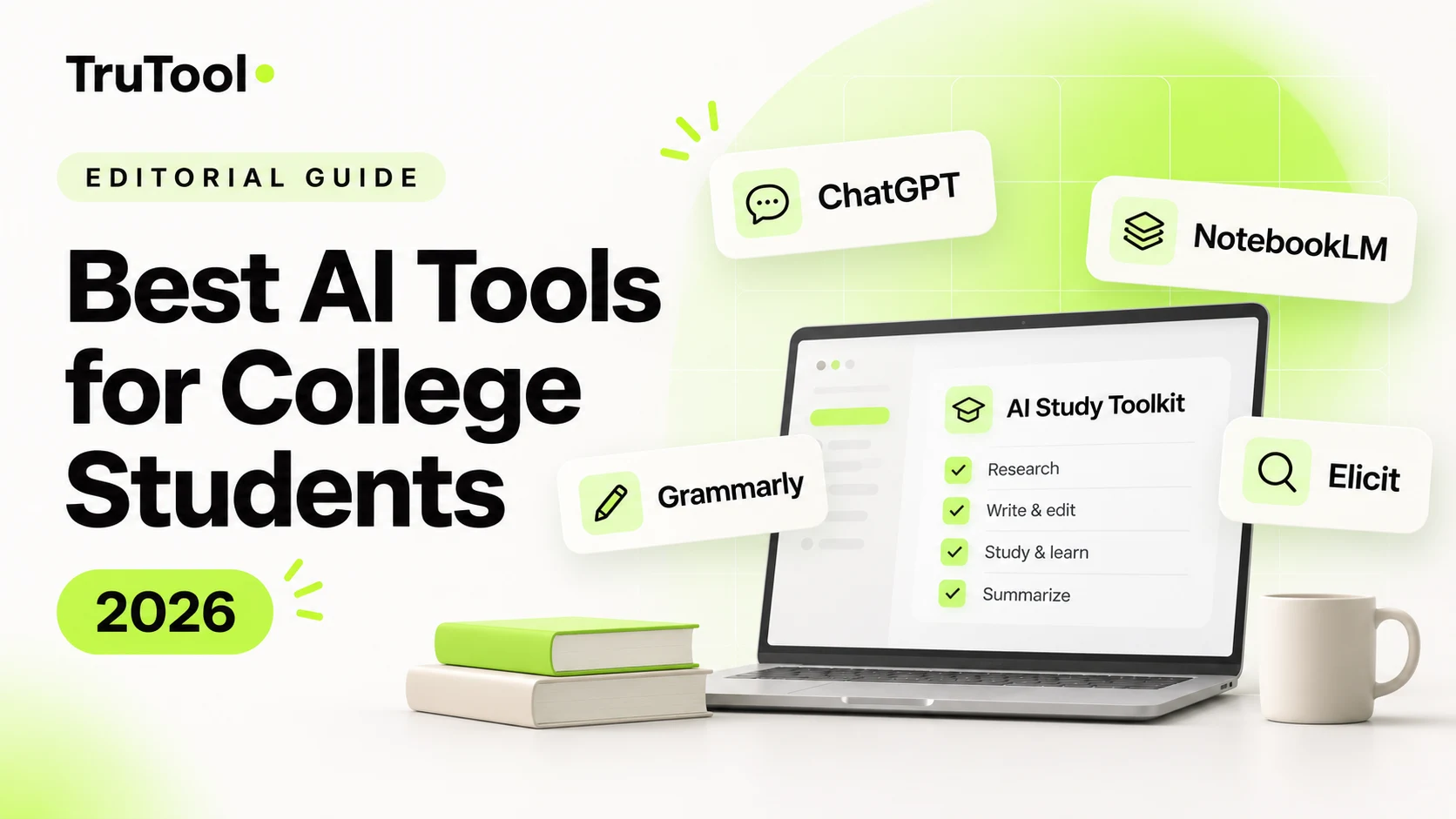
ChatGPT is a practical first choice for students who need interactive explanations and exam preparation. NotebookLM is better for studying uploaded lecture notes and course readings, while Grammarly helps improve essays and assignments. Perplexity works well for exploring topics with linked web sources, and Elicit is more specialized for academic literature reviews.
Otter.ai is useful for recording lectures when permission is available. Claude suits students working through lengthy documents and arguments, while Gemini fits general productivity within Google's ecosystem.
All eight tools offer free access, but their limits differ. Most college students should start with two or three complementary tools rather than pay for several general-purpose AI assistants.
Which AI tools should college students shortlist?
The right shortlist depends on what you spend the most time doing.
Students who struggle with difficult concepts may benefit from ChatGPT's conversational explanations. Someone facing hundreds of pages of assigned reading has a different problem, and NotebookLM may be more useful.
Writing-heavy courses often make Grammarly appealing. Students conducting formal research should compare Elicit with tools such as Perplexity, because finding scholarly evidence is different from searching the open web.
For a typical undergraduate, our starting recommendation is ChatGPT, NotebookLM, and Grammarly. This combination covers explanations, studying existing material, and proofreading without requiring three paid subscriptions.
A useful distinction: An AI assistant can produce a polished answer without producing a reliable one. Academic usefulness depends on whether the explanation is accurate, the evidence can be verified, and the student understands the result.
Keep your existing tools on the shortlist
Not every student needs to replace their current study workflow. University library databases, course notes, instructor-provided resources, and existing accessibility software may already solve the problem.
AI should reduce unnecessary work without removing the independent reading, analysis, and judgment that coursework requires.
Best AI tools for college students compared at a glance
These eight products are ordered by their usefulness for common student tasks rather than a universal performance ranking.
| No. | Platform | Best For | Main Strength | Consideration | Pricing |
|---|---|---|---|---|---|
| 1 | ChatGPT | Studying and exam preparation | Conversational explanations and guided practice | Factual mistakes and inaccurate citations | Free; Plus $20/month |
| 2 | NotebookLM | Course notes and PDFs | Source-based answers and study guides | Limited by uploaded material | Free; expanded access in paid Google AI plans |
| 3 | Grammarly | Essays and proofreading | Grammar, clarity, and editing | Cannot validate academic arguments | Free; Pro $12/month, billed annually |
| 4 | Perplexity | Online research | Web search with linked sources | References require verification | Free; Education Pro $10/month for eligible users |
| 5 | Elicit | Scholarly research | Academic paper discovery and analysis | Research summaries need critical review | Free; Plus $11/month, billed annually |
| 6 | Otter.ai | Lecture transcription | Searchable spoken lecture notes | Free plan has recording limits | Free; Pro from $8.33/month on annual billing |
| 7 | Claude | Long readings and writing feedback | Document analysis and argument review | May misinterpret complex passages | Free; Pro $20/month or $200/year |
| 8 | Google Gemini | General academic productivity | Google ecosystem compatibility | Advanced features vary by plan | Free; Google AI Pro $19.99/month |
The comparison reveals an important difference between general-purpose assistants and specialist tools.
ChatGPT, Claude, and Gemini overlap in their broad capabilities. NotebookLM, Grammarly, Elicit, and Otter.ai serve more specific workflows. Paying for multiple general assistants may therefore offer less value than pairing one assistant with a specialized tool.
Why should students compare different AI study tools?
Students often choose the first popular AI application they encounter. That may be convenient, but it does not always match their coursework.
Four practical differences matter when comparing products.
01. Academic research requires verifiable sources
A general-purpose chatbot can explain research findings, but its response may contain errors or references that do not support the claim.
Students preparing dissertations and literature reviews need a way to find original publications, inspect supporting evidence, and review methodological limitations.
Elicit is designed around scholarly literature. Perplexity provides source-linked web research, which is useful for discovery but does not automatically satisfy academic evidence requirements.
02. Lecture recording and document summarization are different tasks
NotebookLM and Otter.ai both support note-related workflows, but they solve different problems.
Otter converts spoken material into transcripts. NotebookLM helps students work with documents and other sources they already have.
A student attending long seminars may need transcription. Someone reviewing hundreds of pages of readings may need source-based summaries instead.
03. Free plans can be enough for regular coursework
Students do not necessarily need premium subscriptions to improve their study workflow.
ChatGPT can support explanations and practice questions through free access. Grammarly offers basic writing assistance without payment, and NotebookLM provides source-based study features on its free tier.
The more important question is whether a free-plan restriction regularly interrupts an essential task.
04. Academic integrity and privacy matter as much as convenience
An AI tool that quickly produces a finished essay is not automatically suitable for academic work.
Students need to consider university rules, citation practices, document permissions, and how uploaded information is handled.
The strongest product choice is one that supports the student's responsibilities rather than encouraging work they cannot independently explain or verify.
The 8 best AI tools for college students to evaluate
Each profile explains where the tool works especially well, what could make it a poor fit, its pricing approach, and a realistic test students can perform before deciding whether to use it.
1. ChatGPT
Best for: Students who need interactive explanations, practice questions, and everyday study assistance
ChatGPT is a general-purpose AI assistant that helps students discuss unfamiliar concepts, review difficult coursework, and prepare for examinations.
Its main advantage is the ability to continue a conversation. Instead of accepting a single explanation, students can ask for examples, clarify confusing terminology, and work through practice problems.
OpenAI's Study Mode supports guided learning through questions, explanations, and understanding checks.
ChatGPT is relevant across subjects including mathematics, business, economics, history, computer science, and literature. It can also help students discuss assignment requirements and improve the structure of their own work.
Where it can work especially well:
- Explain difficult concepts using examples matched to the student's level.
- Generate practice questions and provide feedback on attempted answers.
- Discuss essay outlines, programming problems, and uploaded study materials.
What to consider: ChatGPT can make factual errors, misunderstand course material, and generate inaccurate references. It should not replace textbooks, instructor guidance, or original academic sources.
Usage allowances and available capabilities also depend on the student's account and plan.
Try it with a real assignment
Choose a difficult topic from an existing lecture.
Ask ChatGPT to explain the topic, provide two examples, and create five practice questions without immediately revealing the answers.
Compare its explanations with your course material. Note any factual mistakes and whether the interaction helped you answer questions independently.
Pricing: ChatGPT has a free plan. ChatGPT Plus costs $20 per month in the US and provides expanded access and higher usage allowances.
Best fit: Students who want one flexible study assistant and prefer learning through questions and feedback.
Official ChatGPT website | Study Mode documentation
2. NotebookLM
Best for: Students reviewing PDFs, lecture slides, course readings, and study materials
NotebookLM, also referred to in Google's current documentation as Gemini Notebook, is designed to work with selected sources rather than answer every question from general knowledge.
Students can add supported documents, PDFs, notes, and websites, then ask questions about their contents.
The source-centered approach is particularly useful when studying for an examination based on a defined set of readings.
NotebookLM can also turn material into summaries, study guides, and Audio Overviews. Its citations help students inspect where information came from.
Where it can work especially well:
- Summarize large collections of course readings and lecture notes.
- Create revision materials and practice questions from selected sources.
- Compare ideas and definitions across multiple uploaded documents.
What to consider: NotebookLM may omit details, misinterpret complicated passages, or produce incomplete answers when source material is missing.
Source citations make checking easier, but they do not establish that every summary is accurate.
NotebookLM is also not a direct replacement for a dedicated lecture transcription application.
Try it with a real assignment
Upload a permitted set of lecture slides and an assigned reading.
Ask NotebookLM to identify the five most important ideas, compare two related theories, and generate ten practice questions.
Check each important claim against the original documents. Record how often a summary needs correction.
Pricing: A free tier is available. Expanded limits and features are included in eligible paid Google AI plans.
Best fit: Students whose main study challenge is reviewing and organizing material they already have.
Official NotebookLM website | Google documentation
3. Grammarly
Best for: Students improving essays, reports, academic emails, and written assignments
Grammarly is an AI-assisted writing tool that identifies grammar, spelling, punctuation, and clarity issues.
Unlike a general assistant that can generate entire essays, Grammarly is particularly useful at the editing stage, when students already have their own draft and want to improve its presentation.
Its suggestions can help remove unnecessary wording, improve sentence flow, and maintain a more consistent writing style.
For students writing frequently, this can make the proofreading process more manageable.
Where it can work especially well:
- Correct spelling, grammar, and punctuation.
- Improve sentence clarity and reduce repetitive language.
- Review writing tone and use advanced editing features in eligible plans.
What to consider: Grammarly cannot determine whether a research argument is sound or whether cited evidence supports a conclusion.
Students should review rewriting suggestions carefully. Editing that changes the substance of an argument may create problems with accuracy, originality, or course rules.
Plagiarism and AI-content checks should not be treated as definitive academic integrity assessments.
Try it with a real assignment
Take a 1,000-word essay you have already written.
Run it through Grammarly and review the suggestions individually.
Check whether the changes make the writing clearer while preserving the original meaning. Reject changes that distort technical terms or academic claims.
Pricing: Grammarly provides a free plan. Grammarly Pro is listed at $12permonthwhenbilledannually($144 per year), or $30 when billed monthly.
Best fit: Students who write their own assignments and want a dedicated proofreading and editing assistant.
Official Grammarly website | Pricing
4. Perplexity
Best for: Students exploring unfamiliar subjects and finding linked research sources
Perplexity combines AI-generated explanations with web search and references.
It can help students begin an assignment, understand current developments, and locate potentially relevant reports or publications.
For students who regularly perform broad online searches, its conversational format makes it easier to narrow a topic through follow-up questions.
The linked references also provide a starting point for verifying information.
Where it can work especially well:
- Explore unfamiliar subjects and current academic topics.
- Identify online references and primary-source starting points.
- Compare different viewpoints and refine research questions.
What to consider: A linked source does not guarantee that the information is correct.
Perplexity may cite an outdated article, misinterpret a publication, or attach a reference that does not fully support its answer.
Students writing research papers should still evaluate the credibility of every source and use university databases when scholarly evidence is required.
Try it with a real assignment
Research a policy or scientific topic that has changed recently.
Ask Perplexity to prioritize official publications and provide source links.
Open five references, check their dates, and determine whether they support the claims in the generated answer.
Pricing: Perplexity has a free Standard plan. Its Pro plan is generally listed at $20 per month, while Education Pro costs $10 per month for eligible verified students and educators.
Best fit: Students who need research starting points and are prepared to inspect original references.
Official Perplexity website | Subscription guide
5. Elicit
Best for: Students preparing literature reviews, dissertations, and research-heavy assignments
Elicit is a specialized AI research assistant focused on scholarly literature.
Rather than treating every webpage as potential research evidence, its central workflows help students discover academic papers, examine findings, and organize research information.
This makes it relevant to postgraduate research and undergraduate projects requiring substantial academic evidence.
Students can use Elicit to investigate research questions, identify candidate papers, and compare information across studies.
Where it can work especially well:
- Search scholarly literature related to a research question.
- Summarize papers and compare their findings.
- Organize research information through structured extraction and export features in supported plans.
What to consider: Elicit cannot replace a systematic literature search or a critical review of research methodology.
An AI summary may omit study limitations, methodological weaknesses, or differences between research populations.
Students should inspect original papers before relying on any extracted findings.
Try it with a real assignment
Use a research question such as: "What relationship does published research identify between sleep duration and academic performance among university students?"
Find five relevant papers in Elicit.
Compare each summary against the original abstract and, where available, the full paper. Check study dates, methods, populations, and limitations.
Pricing: Elicit offers a free Basic plan. Plus starts at $11peruserpermonthwhenbilledannually($132 per year). More specialized research workflows are available in higher tiers.
Best fit: Students who need to find and organize scholarly evidence rather than general web information.
Official Elicit website | Pricing
6. Otter.ai
Best for: Students who need to record and transcribe lectures or academic discussions
Otter.ai is an AI transcription application that converts spoken audio into searchable text.
It can help students revisit information from seminars, online classes, group discussions, and fast-paced lectures.
This is useful when a student finds it difficult to listen carefully and produce detailed handwritten notes at the same time.
Otter can create transcripts with speaker information, recording playback, and AI-assisted summaries.
Where it can work especially well:
- Transcribe lectures and permitted academic recordings.
- Search spoken material for terminology and important explanations.
- Review discussions without relying exclusively on handwritten notes.
What to consider: Automated speech recognition can make mistakes with specialist vocabulary, accents, abbreviations, and overlapping speakers.
Students must also follow their institution's recording policies and obtain permission where necessary.
The free plan may be unsuitable for longer lectures because of its individual recording limit.
Try it with a real assignment
With permission, record a short seminar or study-group discussion.
Review the transcript and compare technical terms, speaker labels, and important explanations against the original audio.
Note the time required to correct mistakes.
Pricing: Otter Basic is free, with up to 300 transcription minutes per month and a 30-minute transcription limit per conversation. Its paid Pro plan offers increased allowances, with published annual pricing starting around $8.33 per user per month.
Best fit: Students who need to capture spoken information, not merely summarize documents.
Official Otter.ai website | Pricing
7. Claude
Best for: Students working through long readings, detailed arguments, and complex writing assignments
Claude is a general-purpose AI assistant developed by Anthropic.
It supports writing, analysis, coding, and discussions involving documents. Students can use it to explore difficult passages, question assumptions, and review the organization of their own arguments.
For humanities students and others working with substantial reading material, this makes Claude a useful alternative to other general-purpose assistants.
Its value depends on how well it interprets the supplied material, not simply how much text it can accept.
Where it can work especially well:
- Discuss lengthy readings and examine arguments.
- Review essay structure and identify reasoning gaps.
- Compare interpretations, coding approaches, or analytical explanations.
What to consider: Claude can misrepresent an author's argument or overlook qualifications in a complicated document.
It can also provide confident but inaccurate explanations. Uploaded texts and generated interpretations should be reviewed against original sources.
Students should check file limits, usage restrictions, and privacy settings before working with coursework.
Try it with a real assignment
Choose an assigned academic reading.
Ask Claude to identify the author's main argument, supporting premises, assumptions, and possible objections.
Compare its interpretation with the original text. Assess whether the tool captured nuance or oversimplified the author's position.
Pricing: Claude offers a free plan. Claude Pro is available for $20 per month, or $200 annually, approximately $17 per month when the annual charge is averaged over 12 months.
Best fit: Students who regularly analyze documents, develop arguments, or want detailed writing feedback.
Official Claude website | TruTool's Claude vs ChatGPT guide
8. Google Gemini
Best for: Students who want general AI assistance alongside Google's productivity ecosystem
Google Gemini is a general-purpose AI assistant that supports explanations, brainstorming, research assistance, and organizing information.
It may suit students already using Google's applications to manage academic documents, schedules, and other everyday tasks.
Gemini can help create study plans, discuss assignment ideas, explain terminology, and work with supported content formats.
Some integrations and advanced workflows depend on account eligibility and subscription plans.
Where it can work especially well:
- Explain concepts and brainstorm academic ideas.
- Organize assignment plans and study schedules.
- Support compatible productivity workflows in eligible Google applications.
What to consider: Gemini can produce inaccurate explanations and incomplete source references.
Students should verify important claims and understand the permissions involved before connecting personal or university-managed information.
Its productivity capabilities also overlap with ChatGPT and Claude, so a second subscription may not always be necessary.
Try it with a real assignment
Provide a list of assignment deadlines, study commitments, and available revision hours.
Ask Gemini to create a weekly study plan with realistic priorities and breaks.
Compare the suggested timetable against your actual calendar. Check whether it handles competing deadlines sensibly.
Pricing: Gemini has free access with usage limits. Google AI Pro is listed at $19.99 per month in the US, with expanded AI access and eligible Google service benefits.
Best fit: Students who want general academic assistance and already rely on Google's ecosystem.
Official Gemini website | Google AI plans
How to choose an AI study tool fairly
The most useful comparison is not which product generates the longest response. It is which product helps you complete a real academic task accurately, with less unnecessary effort.
Bring the same reading, assignment, or research question to the tools you are considering.
Evaluate their output using consistent criteria.
| Evaluation Criterion | What to Verify | Why It Matters |
|---|---|---|
| Academic accuracy | Are explanations and calculations correct? | Incorrect information can weaken understanding |
| Source transparency | Can important claims be traced to original material? | Academic work requires verifiable evidence |
| Learning value | Can you explain the answer independently afterward? | Producing an answer is not the same as learning |
| Practical workflow | Does the tool handle your actual documents or tasks? | General features may not fit course requirements |
| Free-plan limits | Can you finish a realistic assignment without upgrading? | Usage restrictions affect real cost |
| Privacy and permissions | Can you use course material under applicable rules? | Student and institutional data require care |
| Total cost | What is the yearly cost after discounts and billing terms? | Several subscriptions can become expensive |
Compare the full subscription cost
Consider a student who subscribes to ChatGPT Plus, Grammarly Pro on annual billing, and Elicit Plus on annual billing.
Their published monthly-equivalent cost would be:
- ChatGPT Plus: $20
- Grammarly Pro: $12
- Elicit Plus: $11
That is $43 per month on average, or $516 across 12 months, before taxes and regional discounts.
The Grammarly and Elicit amounts require annual billing commitments. This calculation illustrates the combined cost; it is not a claim that most students need all three subscriptions.
Before paying, check whether your institution already provides approved software or discounted access.
A practical 14-day evaluation before choosing your AI toolkit
Instead of paying immediately, use two weeks to evaluate a few tools against real coursework.
Days 1–3: Establish your current study workflow
Identify where you spend the most time.
It might be understanding mathematics, reviewing lectures, searching for sources, or editing essays.
Choose one representative task and record how long it takes without the new tool.
Also note which resources your institution already provides.
Days 4–10: Test three shortlisted tools
Choose tools that address your main problem.
For example, a research student could compare Elicit, Perplexity, and a university academic database.
A student revising for exams might compare ChatGPT, NotebookLM, and their existing note-taking approach.
Use the same material and evaluate accuracy, source quality, manual corrections, and whether the output improves understanding.
For transcription tools, test only recordings you are permitted to use.
Days 11–14: Review limitations, costs, and results
Look at what the tools actually accomplished.
Did they reduce the time spent organizing notes? Did they help you understand difficult material? Did they identify useful academic sources?
Also check the cost of overcoming any free-plan restrictions.
Select the smallest tool combination that meets your needs.
Do not replace your entire study system on day one. Keep original materials, verify AI-generated content, and retain the research and note-taking practices that already work.
Students who want to compare general-purpose assistants in more detail can read TruTool's Claude vs ChatGPT guide.
Frequently asked questions about AI tools for college students
What is the best AI tool for college students in 2026?
ChatGPT is our general recommendation for interactive studying and explanations. NotebookLM suits source-based revision, Grammarly helps with writing, and Elicit supports scholarly research. The best tool depends on the student's main task.
Which AI tools are free for students?
ChatGPT, NotebookLM, Grammarly, Perplexity, Elicit, Otter.ai, Claude, and Gemini offer free access. However, free plans may restrict message usage, advanced features, document processing, recording time, or research capabilities.
Which AI tool is best for academic research?
Elicit is a specialized option for discovering and reviewing scholarly publications. Perplexity is useful for finding general web sources and exploring current topics. Students should continue using original papers and university databases when formal academic evidence is required.
Which is better for college students: ChatGPT or Claude?
ChatGPT is a flexible option for study conversations, explanations, and practice questions. Claude is also useful for document analysis, argument development, and writing feedback. Both can make factual errors, so students should compare them using real coursework rather than assuming one is universally superior.
What is the best AI tool for college lecture notes?
Otter.ai is designed to record and transcribe spoken material, provided recording is permitted. NotebookLM is better suited to studying existing notes, PDFs, and readings. The two products can be complementary.
Can AI tools write college assignments?
Some tools can generate draft text, outlines, and writing suggestions. Whether that use is allowed depends on the institution, course, and assignment. Students remain responsible for their permitted contribution, original analysis, citations, and compliance with academic integrity rules.
Are paid AI subscriptions worth it for college students?
Paid subscriptions may make sense when students regularly need more research capacity, longer transcription allowances, or expanded document analysis. For occasional studying, free plans are often sufficient. Check institutional subscriptions before purchasing individual plans.