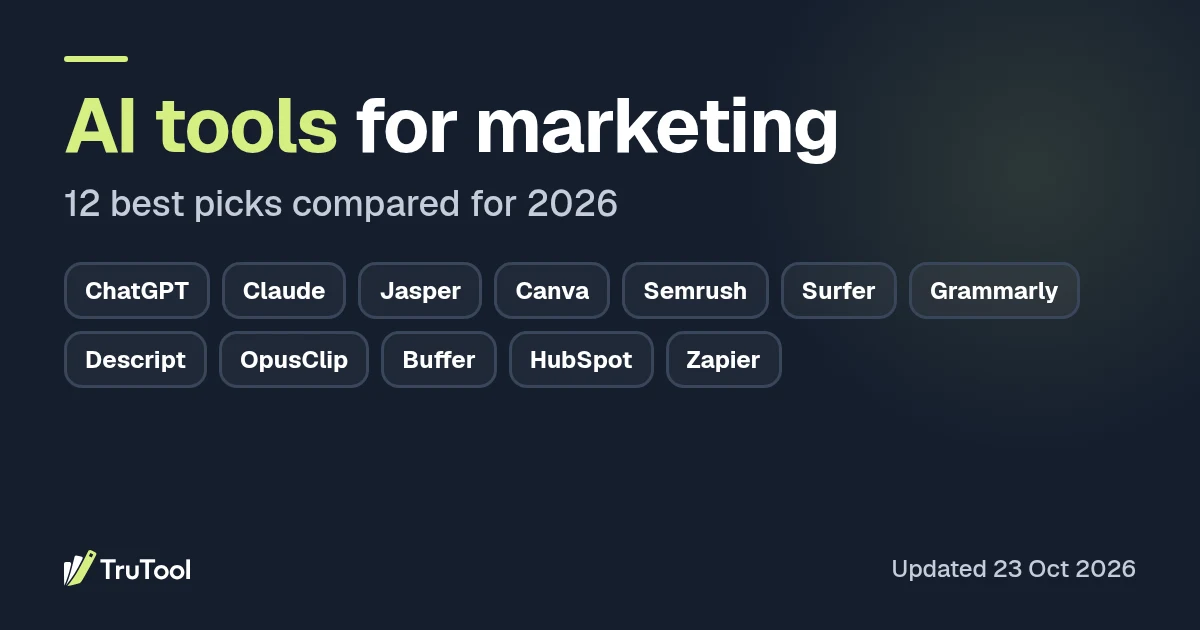
Quick answer: The best AI tools for marketing in 2026 are ChatGPT and Claude for drafting, Jasper for brand content, Semrush and Surfer for SEO, Canva for design, Descript and OpusClip for video, Buffer for social, HubSpot for automation and Zapier for connecting apps. Nine of the 12 have a full free plan.
Picking AI tools for marketing starts with one bottleneck and one tool that fixes it. We checked the official pricing page of every tool below on October 23, 2026. Prices change often, so confirm before you buy.
Key facts at a glance
- ChatGPT Plus costs $20/month, billed monthly only, per OpenAI's help center.
- Claude Pro costs $17/month on annual billing or $20 monthly.
- Jasper has no free plan. Pro is $59/seat/month yearly or $69 monthly.
- Semrush's SEO plan is $139/month, or $117.33/month billed annually.
- Buffer starts at $5 per channel per month on Essentials.
- Canva Pro is from $144 a year, and HubSpot Marketing Hub Starter lists at $20 per seat per month.
- Nine tools offer a full free plan: ChatGPT, Claude, Canva, Grammarly, Descript, OpusClip, Buffer, HubSpot and Zapier. Semrush adds a limited free AI Visibility tier.
What are the best AI tools for marketing in 2026?
The best AI tools for marketing in 2026 are ChatGPT, Claude, Jasper, Canva, Semrush, Surfer, Grammarly, Descript, OpusClip, Buffer, HubSpot and Zapier. Each one wins a different marketing job. Most teams need three or four of them, one per bottleneck.
The table below compares them on price, free access and fit.
| Tool | Best for | Free plan | Starting paid price (official page, Oct 23, 2026) | Main weakness |
|---|---|---|---|---|
| ChatGPT | Drafting, research, images | Yes | Plus $20/mo (monthly only) | No annual billing for Plus |
| Claude | Long-form writing, analysis | Yes | Pro $17/mo annual, $20 monthly | Heavy users get pushed to Max, from $100/mo |
| Jasper | On-brand content for teams | No (free trial) | Pro $59/seat/mo yearly, $69 monthly | Priced per seat, costly for big teams |
| Canva | Social and ad design | Yes | Pro from $144/year | Trial AI allowance equals the free plan |
| Semrush | SEO and AI search visibility | No full plan (limited free AI Visibility tier) | SEO $139/mo, $117.33/mo annual | Expensive for solo marketers |
| Surfer | Content optimization | No | Discovery $49/mo billed yearly | AI visibility tracking starts at a higher tier |
| Grammarly | Editing and tone | Yes | Pro $12/mo billed annually ($144/yr) | Best price needs an annual commitment |
| Descript | Video and podcast editing | Yes | Hobbyist $16/mo annual, $24 monthly | Media hours and AI credits are capped per plan |
| OpusClip | Short clips from long video | Yes (60 credits/mo) | Starter $15/mo | Credit-based, long videos burn credits fast |
| Buffer | Social scheduling | Yes | Essentials $5/channel/mo | Cost scales with every channel you add |
| HubSpot | CRM-led marketing automation | Yes (up to 2 users) | Marketing Hub Starter from $20/seat/mo list | Professional jumps to $890/mo |
| Zapier | Connecting your stack | Yes | Professional from $19.99/mo | Complex Zaps get pricey on higher plans |
How did we choose these AI marketing tools?
We chose tools that cover one clear marketing job, publish pricing on an official page, and are named in current top-ranking roundups from HubSpot, Zapier and Search Engine Land. We left out tools that hide pricing entirely, because buyers cannot compare them. This list also leaves out ad-platform features such as Google Ads Smart Bidding and Meta Advantage+, and email-first platforms like Klaviyo, which suit a separate guide.
Each tool below lists one weakness, drawn from its pricing page and plan limits.
Browse every tool we list in marketing tools.
Which AI tools are best for writing marketing content?
ChatGPT, Claude, Jasper and Grammarly are the strongest AI writing tools for marketers. ChatGPT and Claude are general assistants that draft, research and rework copy. Jasper adds brand controls for teams. Grammarly sits on top of all of them as an editor.
1. ChatGPT
Best for: Drafting, research and images
ChatGPT is the most flexible starting point. The free plan includes unlimited text chats, limited image creation and limited deep research, per OpenAI's pricing page.
Plus costs $20/month and adds expanded deep research, projects, scheduled tasks and custom GPTs. That makes it useful for recurring jobs like weekly content briefs.
Weakness: Plus has no annual billing option, so there is no discount for committing. The Go plan may also include ads.
Read our ChatGPT review or compare it in Claude vs ChatGPT.
2. Claude
Best for: Long-form writing and analysis
Claude suits long-form writing and analysis, such as turning research notes into a whitepaper draft. There is a free plan.
Claude Pro is $17/month on annual billing or $20 monthly. Team standard seats are $20/seat/month annually or $25 monthly.
Weakness: marketers who work in it all day can hit limits, and Max starts at $100/month.
See our Claude review.
3. Jasper
Best for: On-brand content for teams
Jasper is built for marketing teams that need many writers to sound like one brand. It positions itself on brand consistency at scale.
Pro is $59/seat/month billed yearly or $69 monthly. A free trial is available.
Weakness: there is no free plan, and per-seat pricing adds up quickly for larger teams.
More in our Jasper review.
4. Grammarly
Best for: Editing and tone
Grammarly checks grammar, clarity and tone across email, docs and social posts. The free plan covers spelling and grammar.
Pro is $12/month billed annually, which is $144 a year.
Weakness: the advertised price assumes annual billing, and the tool only works on copy you have already written.
See the Grammarly review.
Which AI tools help with SEO and AI search?
Semrush and Surfer are the two picks here. Semrush covers keyword research, competitor data and AI visibility tracking in one suite. Surfer focuses on optimizing individual pages so they cover a topic fully. Pick Semrush for research breadth and Surfer for on-page work.
5. Semrush
Best for: SEO and AI search visibility
Semrush is an SEO suite for keyword research, competitor analysis and tracking brand visibility in AI search. Its SEO plan costs $139/month, or $117.33/month billed annually. Its pricing page also lists a free AI Visibility tier for trying the platform.
Weakness: the entry price is high for freelancers, and extra users start at $45/month each.
Read our Semrush review.
6. Surfer
Best for: Content optimization
Surfer's Discovery plan is $49/month billed yearly and covers drafting and optimizing content. AI search analytics across ChatGPT and other engines appear on higher plans, from $82/month billed yearly.
Weakness: no free plan, and the AI visibility features sit above the entry tier.
See our Surfer review.
Which AI tools are best for marketing design and video?
Canva is the default for design. Descript and OpusClip split video: Descript edits long recordings like webinars and podcasts by editing the transcript, and OpusClip cuts long videos into short social clips. All three have a free plan, so you can test before paying.
7. Canva
Best for: Social and ad design
Canva is free for individuals. Canva Pro starts from $144 a year for one person in the US, before tax, and adds Brand Kits, Magic Resize, Magic Write, background removal and AI ad creation with Canva Grow, per Canva's Pro page.
Weakness: Canva says the AI allowance during a Pro trial is the same as Canva Free, so you cannot fully test AI limits before paying. Pro is also limited to one person.
See our Canva review and Figma vs Canva.
8. Descript
Best for: Video and podcast editing
Descript lets you edit video by editing text. The free plan is a starting point. Hobbyist is $16/month billed annually or $24 monthly, with 10 media hours and 400 AI credits a month.
Weakness: media hours and AI credits are capped on every plan, which heavy video teams will feel.
More in the Descript review.
9. OpusClip
Best for: Short clips from long video
OpusClip turns long videos into short clips. The free plan gives 60 credits per month. Starter is $15/month with 150 credits, and Pro is $29/month.
Weakness: everything runs on credits, so long source videos use your allowance fast.
See the OpusClip review.
Which AI tools handle social media and automation?
Buffer, HubSpot and Zapier cover distribution and automation. Buffer schedules social posts cheaply, HubSpot runs email and CRM-driven campaigns, and Zapier connects every other tool on this list so content moves between them without copy and paste.
10. Buffer
Best for: Social scheduling
Buffer's free plan connects up to 3 channels with 10 scheduled posts per channel. Essentials is $5/month per channel and Team is $10/month per channel, billed yearly.
Weakness: pricing is per channel, so a brand on six networks pays six times the base rate.
See our Buffer review or the Hootsuite review.
11. HubSpot
Best for: CRM-led marketing automation
HubSpot Marketing Hub combines CRM, email and automation with AI agents. The free plan covers up to 2 users. Marketing Hub Starter lists at $20/month per Core Seat with 1,000 marketing contacts and 500 HubSpot Credits a month, per HubSpot's product catalog.
Weakness: the jump from Starter to Professional is steep, as Professional starts at $890/month. Extra AI usage is billed in credits, which makes costs harder to predict.
Read the HubSpot review and our marketing platform checklist.
12. Zapier
Best for: Connecting your stack
Zapier connects your marketing apps. The free plan includes Zaps, Tables and Forms with 100 tasks per month. Professional starts at $19.99/month and Team at $69/month.
Weakness: costs rise as automations get more complex, and AI agents and chatbots are priced as separate add-ons.
See the Zapier review.
How do you choose the right AI tool for marketing?
Choose the right AI tool for marketing by naming the one task that slows your team most, then picking the cheapest tool that fixes it. Test it on the free plan or trial for real work, check how pricing scales with seats, channels or credits, and only then commit annually.
A simple order works for most small teams:
- Start with one general assistant (ChatGPT or Claude).
- Add one channel tool where you publish most (Canva, Buffer or Descript).
- Add SEO tooling once content volume justifies it.
- Connect everything with Zapier last.
For a deeper buying checklist, see How to choose marketing platforms.
Frequently asked questions
What are the best AI tools for marketing?
The best AI tools for marketing in 2026 include ChatGPT and Claude for writing, Jasper for brand content, Semrush and Surfer for SEO, Canva for design, Descript and OpusClip for video, Buffer for social, HubSpot for automation and Zapier for connecting apps.
Are there free AI tools for marketing?
Yes. ChatGPT, Claude, Canva, Grammarly, Descript, OpusClip, Buffer, HubSpot and Zapier all have full free plans as of October 2026, and Semrush has a limited free AI Visibility tier. Free tiers have usage limits, so they suit testing and light use.
Which AI marketing tool is best for small businesses?
For small businesses, ChatGPT or Claude plus Canva covers most needs at low cost. Add Buffer at $5 per channel for scheduling. Move to Semrush or HubSpot once traffic and lead volume justify the higher price.
Is ChatGPT enough for marketing?
ChatGPT handles drafting, research and images well, but it does not schedule posts, track rankings or run email campaigns. Most teams pair it with a design tool, a social scheduler and an SEO tool.
How much do AI marketing tools cost?
Entry-level paid plans range from $5 per channel per month (Buffer Essentials) to $139/month (Semrush SEO, billed monthly). Most writing assistants cost around $20/month. Team and pro tiers run higher, for example HubSpot Marketing Hub Professional from $890/month.